Description
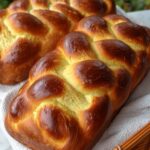
Portuguese Easter Bread is a traditional sweet yeast bread braided beautifully and enriched with warm milk, butter, eggs, and plump raisins soaked in boiling water. This soft, golden bread is perfect for festive occasions or as a delightful treat with butter or jam.
Ingredients
Scale
Main Ingredients
- 1 and 1/2 Cups very warm milk
- 1 cup white sugar + 1 tsp sugar
- 1/2 cup (8 Tbsp) unsalted butter, softened
- 1 tsp salt
- 2 envelopes active dry yeast (1 and 1/2 Tbsp)
- 3 eggs, well beaten
- 6 1/2 Cups unsifted all-purpose flour
- 3/4 to 1 cup white or brown raisins
- 2 cups boiling water
For Egg Wash
- 1 egg
- 1 tsp water
Instructions
- Prepare Raisins: Place 1 cup of white or brown raisins in a bowl with 2 cups of boiling water and let them soak for 10 minutes. Drain the raisins well and set aside.
- Proof Yeast: Pour 1/2 cup warm milk (heated for 30 seconds in the microwave) into a large measuring cup. Add 1 tsp sugar and sprinkle the active dry yeast over the top. Stir gently and let it stand until bubbly and doubled in volume, about 10 minutes.
- Mix Wet Ingredients: Combine 1 cup of very warm milk (heated 1 minute in microwave) with 1 cup sugar, softened butter, and 1 tsp salt in a large bowl. Stir until most of the butter melts.
- Add Eggs and Yeast: Stir in the 3 well-beaten eggs, then add the yeast mixture into the butter mixture. Using a dough hook attachment or a wooden spoon, gradually beat in 6 1/2 cups of flour one cup at a time until a soft dough forms.
- Knead Dough: Knead the dough for 8-12 minutes until smooth and elastic. It may still be slightly sticky but should not stick to your fingers. If kneading by hand, turn dough onto a floured surface and knead with only enough flour to prevent sticking.
- Add Raisins: Stir in the drained raisins evenly into the dough.
- First Rise: Transfer the dough to a large buttered bowl, turning it so the buttered side is up. Cover with a tea towel and let rise in a warm, draft-free spot (around 100°F) for about 1 and 1/2 hours or until doubled in size.
- Punch Down and Divide: Punch down the dough and turn it onto a floured surface. Divide the dough in half. Take one half and divide it into four equal pieces, shaping each piece into about 15-inch strips.
- Braid Dough: Pinch the four strips together on one end to start the braid.
- Braid Step 1: Cross the far right strip over its neighbor.
- Braid Step 2: Tuck the far left strip under its neighbor and then over the next strip. Repeat these steps until you finish braiding and pinch the other end together.
- Second Rise: Place each braid in a buttered baking dish. Cover loosely with a towel and let them sit for 30 minutes to rise further.
- Preheat Oven: After the braids have rested, preheat the oven to 375°F.
- Egg Wash: Beat together 1 egg and 1 tsp water. Generously brush this egg wash over the top and sides of the braided breads just before baking.
- Bake: Bake each loaf separately for 20-22 minutes or until golden brown and cooked through.
Notes
- Use very warm milk to activate the yeast properly but avoid overheating which could kill the yeast.
- Raisins soaking in boiling water soften them and prevent them from drying out during baking.
- Kneading is essential for gluten development; dough will be slightly sticky but manageable.
- Allowing the dough to rise twice (before and after braiding) ensures soft, airy bread.
- Use a buttered baking dish rather than a large pan to allow for expansion during baking.
- Egg wash gives the bread a glossy, golden crust.